
On July 5, the 2026 China Annual Conference of the China Economic Society (CES) was held at Southwestern University of Finance and Economics. Founded in 1985, the China Economic Society is a globally influential academic organization for Chinese economists and an authoritative international platform for research on China’s economic issues. Its annual China conference, hosted on a rotating basis by top-tier universities across China, has evolved into a flagship annual event in the global economics community.
Centered on the theme of “Technology-Driven Growth Amid Global Economic Changes: Artificial Intelligence, Green Transition and the Rebalancing of China’s Macroeconomy”, this year’s conference invited Yu Miaojie, President of Liaoning University, to attend the forum themed “China's Development and Micro Evidence” and deliver a keynote speech titled “Understanding China’s High-Quality Development”.
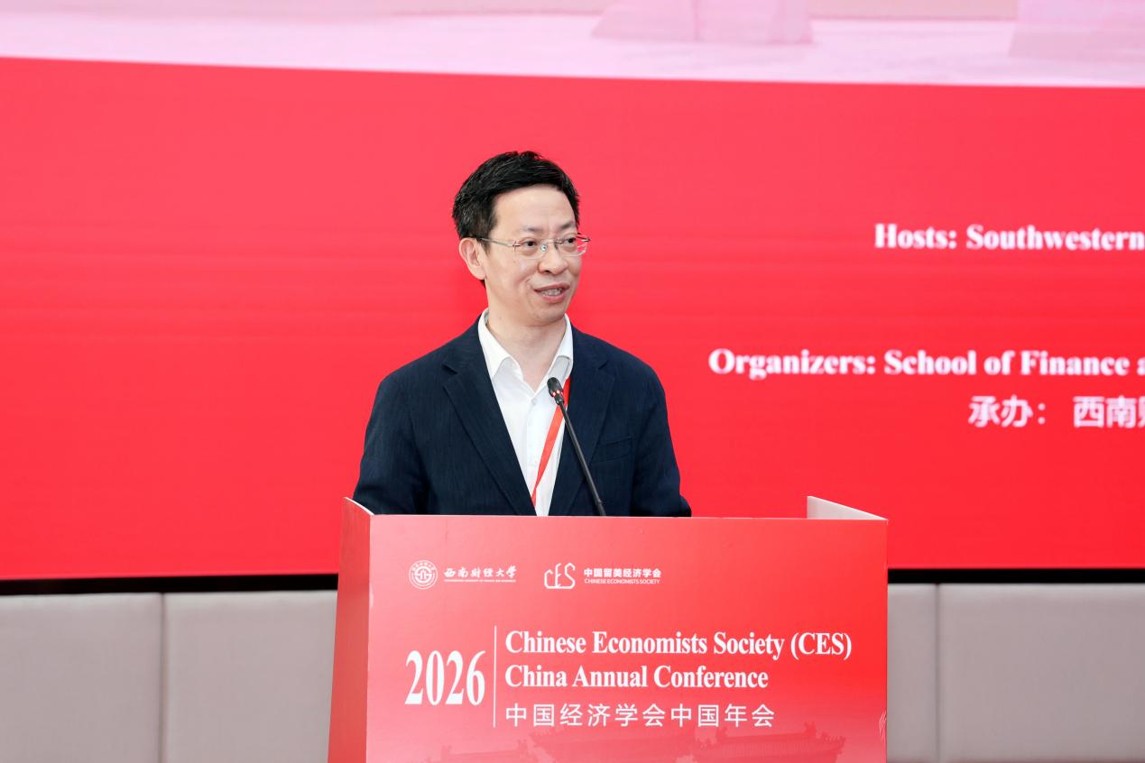
Yu Miaojie systematically elaborated on the core manifestations of China’s high-quality economic development, pointing out that it is mainly reflected in six dimensions: improved product added value, upgraded product quality, higher total factor productivity of enterprises, the establishment of advantages in industrial chains, industrial agglomeration, and the optimization of the structure of the primary, secondary and tertiary industries. In terms of the proportion of the three major industries in China’s economy (the primary industry accounts for 6.7 percent, the secondary industry 35.6 percent, and the tertiary industry 57.7 percent), the tertiary industry occupies a dominant position. Yu Miaojie specially emphasized that the tertiary industry serves as the key driver of employment creation.
Focusing on how the five new development philosophies empower high-quality development, Yu Miaojie stated that innovation acts as the fundamental driving force for high-quality development. In 2025, China’s research and development (R&D) intensity reached 2.8 percent, exceeding the average level of OECD member countries. Nevertheless, there remains a gap in investment in basic research between China and the United States. In interpreting new quality productive forces, Yu Miaojie noted that their connotation differs from traditional total factor productivity, and is mainly embodied in three aspects: the iterative upgrading of product technology, the innovative allocation of production factors, and the in-depth transformation and upgrading of industries.
He further pointed out that the most vibrant innovation is not generated by leading enterprises, but by mid-tier enterprises facing fierce market competition. This phenomenon reflects the profound impact of market competition patterns on innovation incentives.
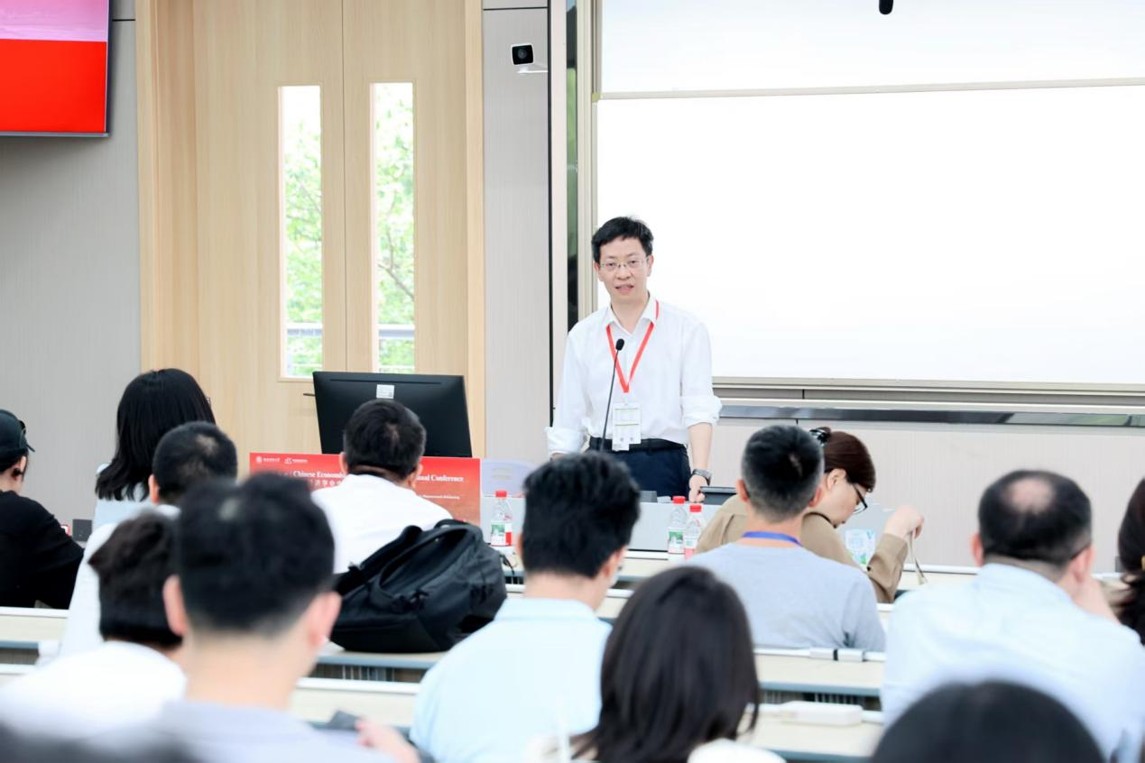
In terms of green development, Yu Miaojie pointed out that the United States has contributed 29 percent of the world’s cumulative carbon emissions since the Second Industrial Revolution. As a late-developing country, China has been actively shouldering its responsibilities as a major global power. In accordance with the goals of the 15th Five-Year Plan, the share of non-fossil energy consumption is expected to reach 25 percent by 2030. The proportion stood at 21.07 percent in 2025, a notable increase from 15 percent in 2019, yet an annual growth of approximately one percentage point is still required to meet the target. He particularly stressed that policy implementation must adhere to the principle of “establishing the new before phasing out the old”. It is essential to develop new energy sources first and then gradually reduce the proportion of traditional energy to avert the risk of energy shortages.
In terms of coordinated development, Yu Miaojie argued that the core lies in the synchronized advancement of industrialization and urbanization. At present, urbanization development lags behind industrialization in China, making it urgent to shore up weak links in urbanization. He suggested prioritizing the development of five major urban agglomerations, with the Yangtze River Delta serving as the leading engine. Meanwhile, China should vigorously develop county-level economies and promote coordinated development of regions, urban and rural areas as well as synergized policy implementation in light of local conditions.
In terms of shared development, Yu Miaojie systematically elaborated on the principle of “raising low incomes, expanding middle-income groups, and regulating high incomes” for common prosperity. Specifically, “raising low incomes” refers to boosting the earnings of low-income groups and preventing large-scale return to poverty among people who have been lifted out of poverty. “Expanding middle-income groups” means enlarging the size of the middle-income population, while “regulating high incomes” refers to standardizing and adjusting the income of high-income groups.
In terms of open development, Yu Miaojie stated that globalization remains an ongoing trend with two unchanged core features: regionalized product production and multilateralized trade. Nevertheless, the WTO framework is facing severe challenges, and the effectiveness of the multilateral trading system has been weakened. The global economic and trade landscape has formed a tripartite pattern, consisting of the US-centered USMCA system, the RCEP with in-depth Chinese participation, and the integrated regional bloc of the European Union. In this context, China continues to advance high-level opening-up.
Yu Miaojie clarified the specific paths for China’s independent opening-up. First, diversify export destinations to reduce reliance on the U.S. market. Second, expand service trade and enhance export competitiveness in deficit sectors including education, tourism and transportation. Third, drive the transformation of enterprises’ “going global” strategy, shifting focus from large-scale infrastructure projects to small yet high-quality livelihood-oriented projects. Fourth, improve the quality of foreign investment introduction and optimize the regional layout of foreign capital. Fifth, promote differentiated development of the Belt and Road Initiative. Expand land-based cooperation toward the Russian Far East, deepen maritime cooperation with the Middle East and North Africa, and accelerate the formation of an opening-up pattern featuring coordinated land and sea development as well as interconnected eastern and western regions.
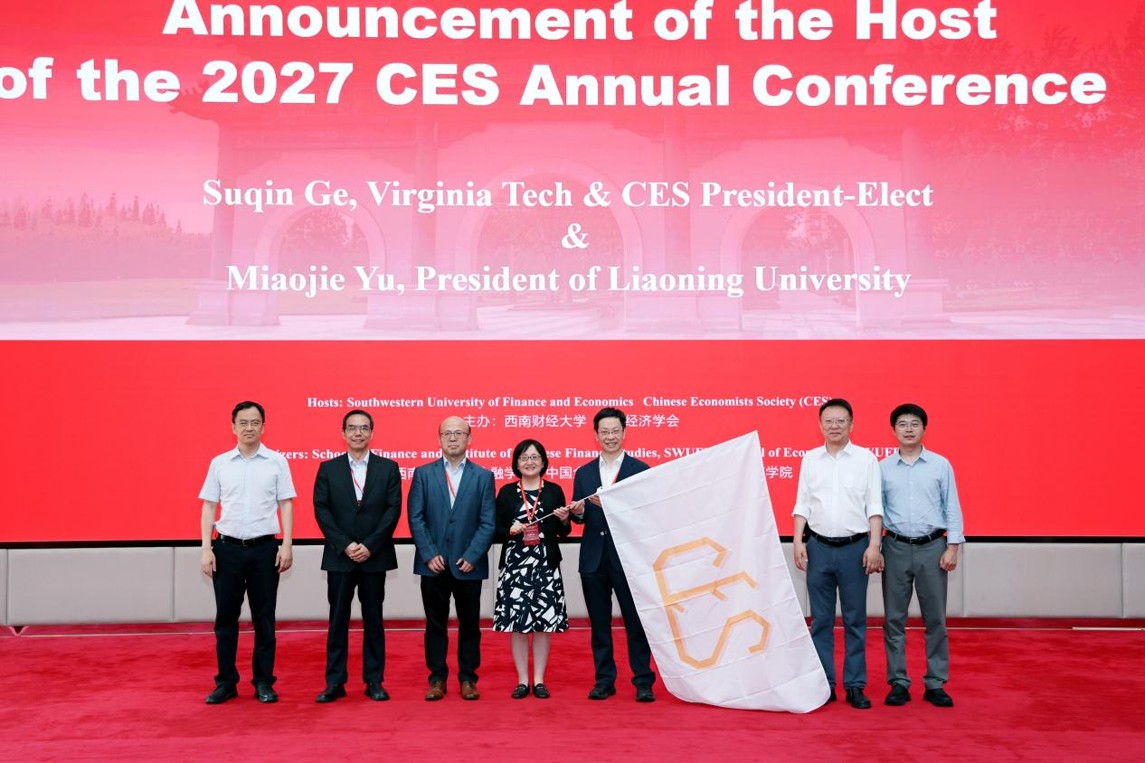
At the closing ceremony of the annual conference, President Yu Miaojie gave a detailed introduction to all delegates regarding Liaoning University’s profound historical heritage and major achievements. Together with Professor Ge Suqin, President of the Chinese Economists Society (CES), he received the conference flag, marking Liaoning University as the official host institution for the 2027 CES China Annual Conference.
Meanwhile, President Yu extended an invitation to economists at home and abroad, expressing his anticipation that scholars will gather at Liaoning University for next year’s grand conference to jointly contribute to developing an independent knowledge system of Chinese economics.